

What is the power factor control accuracy of a Power Factor Improvement Panel?
Nov 18, 2026
Leave a message
As a supplier of Power Factor Improvement Panels, I've often been asked about the power factor control accuracy of these panels. In this blog, I'll delve into what power factor control accuracy means, why it's crucial, and how our panels achieve high - precision control.
Understanding Power Factor
Before we discuss control accuracy, let's briefly understand what power factor is. Power factor (PF) is the ratio of real power (P), which is used to do useful work, to apparent power (S), which is the product of voltage and current in an AC circuit. Mathematically, (PF=\frac{P}{S}). A power factor of 1 (or 100%) indicates that all the electrical power is being used effectively, while a lower power factor means that a significant portion of the power is being wasted in the form of reactive power.
Reactive power is required to establish and maintain the magnetic fields in inductive loads such as motors, transformers, and fluorescent lighting. However, it doesn't contribute to the actual work done by the load. Utilities often charge industrial and commercial customers for low power factor because it increases the current flowing through the electrical system, leading to higher losses and reduced capacity.
The Importance of Power Factor Control Accuracy
Power factor control accuracy is of utmost importance for several reasons. Firstly, accurate power factor control helps in reducing energy costs. By maintaining a high power factor, customers can avoid penalties imposed by utilities for low power factor. For example, if a factory has a power factor of 0.7 and the utility charges a penalty for power factors below 0.9, the factory will end up paying more for the same amount of real power used. With accurate power factor control, the factory can bring its power factor up to the required level and save on energy costs.
Secondly, it improves the efficiency of the electrical system. When the power factor is close to 1, the current flowing through the system is minimized. This reduces the resistive losses in the cables, transformers, and other electrical equipment, leading to lower operating temperatures and longer equipment life.
Thirdly, accurate power factor control increases the capacity of the electrical system. Since the current is reduced, more real power can be transmitted through the same electrical infrastructure without overloading it. This is particularly important for industries that are planning to expand their operations or increase their production capacity.
How Power Factor Improvement Panels Work
Power Factor Improvement Panels are designed to correct the power factor of an electrical system by adding or removing capacitors in parallel with the load. Capacitors generate reactive power that is opposite in phase to the reactive power generated by inductive loads. By adjusting the amount of capacitance connected to the system, the panel can compensate for the reactive power and improve the power factor.
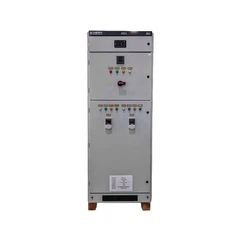
A Power Factor Controller Panel, Power Factor Controller Panel is the brain of the Power Factor Improvement Panel. It continuously monitors the power factor of the system and sends signals to the switching devices in the panel to connect or disconnect the capacitors as needed. The accuracy of the power factor control depends on the performance of the controller and the quality of the components used in the panel.
Factors Affecting Power Factor Control Accuracy
Several factors can affect the power factor control accuracy of a Power Factor Improvement Panel.
1. Controller Accuracy
The power factor controller is responsible for measuring the power factor and making decisions about when to switch the capacitors. A high - quality controller with accurate sensors and advanced algorithms can provide better control accuracy. For example, some controllers use digital signal processing (DSP) technology to measure the power factor with high precision and can adjust the capacitor switching based on real - time changes in the load.
2. Capacitor Tolerance
Capacitors have a certain tolerance in their capacitance value. If the actual capacitance of the capacitors in the panel deviates from the rated value, it can affect the power factor correction. For instance, if a capacitor is supposed to have a capacitance of 100 μF but has an actual value of 90 μF, it will generate less reactive power than expected, leading to a lower power factor correction.
3. Load Variation
The power factor of a system can change rapidly due to load variations. For example, in a manufacturing plant, the power factor may change when a large motor starts or stops. A Power Factor Improvement Panel needs to be able to respond quickly to these changes to maintain accurate power factor control.
4. Environmental Conditions
Environmental factors such as temperature, humidity, and voltage fluctuations can also affect the performance of the Power Factor Improvement Panel. High temperatures can cause the capacitors to age faster and reduce their capacitance, while voltage fluctuations can affect the accuracy of the power factor measurement.
Our Approach to Achieving High - Precision Power Factor Control
As a supplier of Power Factor Improvement Panel, we take several steps to ensure high - precision power factor control.
1. High - Quality Controllers
We use state - of - the - art power factor controllers that are designed to provide accurate power factor measurement and control. Our controllers are equipped with high - precision sensors and advanced algorithms that can adapt to different load conditions and provide fast response times.
2. Low - Tolerance Capacitors
We source capacitors with low tolerance values to ensure that the actual capacitance is close to the rated value. This helps in achieving more accurate power factor correction.
3. Advanced Monitoring and Communication
Our Power Factor Improvement Panels are equipped with advanced monitoring and communication features. They can continuously monitor the power factor, capacitor status, and other parameters and send the data to a central control system. This allows for remote monitoring and control, and also enables us to diagnose and troubleshoot any issues quickly.
4. Robust Design
We design our panels to be robust and reliable, able to withstand harsh environmental conditions. We use high - quality components and follow strict manufacturing standards to ensure the long - term performance of our panels.
Case Studies
Let's look at a few case studies to illustrate the importance of power factor control accuracy.
Case Study 1: A Manufacturing Plant
A manufacturing plant was experiencing high energy costs due to a low power factor. They installed our Power Factor Improvement Panel with high - precision control. After installation, the power factor improved from 0.75 to 0.95. As a result, the plant was able to avoid the power factor penalty and reduce its energy consumption by 15%.
Case Study 2: A Commercial Building
A commercial building had a variable load due to the use of different types of equipment such as air - conditioning units, elevators, and lighting. Our Power Factor Improvement Panel was able to respond quickly to the load variations and maintain a power factor of over 0.9. This not only saved energy costs but also improved the efficiency of the electrical system.
Conclusion
Power factor control accuracy is a critical aspect of Power Factor Improvement Panels. It can have a significant impact on energy costs, system efficiency, and capacity. As a supplier, we are committed to providing high - quality panels that can achieve accurate power factor control. Our panels are designed to overcome the challenges posed by factors such as controller accuracy, capacitor tolerance, load variation, and environmental conditions.
If you are interested in improving the power factor of your electrical system and want to learn more about our Power Factor Improvement Panel, please feel free to contact us for a detailed discussion. We are ready to provide you with customized solutions based on your specific requirements.


References
- Electric Power Systems Quality, by Roger C. Dugan, Mark F. McGranaghan, and Surya Santoso.
- Power Factor Correction Handbook, by Cooper Bussmann.
Send Inquiry