

Can a Power Factor Controller Panel improve energy efficiency?
Nov 24, 2026
Leave a message
In today's energy - conscious world, the pursuit of energy efficiency is a top priority for industries and commercial establishments alike. As a supplier of Power Factor Controller Panels, I am often asked whether these panels can truly improve energy efficiency. In this blog, I will delve into the science behind power factor, explain how Power Factor Controller Panels work, and discuss their impact on energy efficiency.
Understanding Power Factor
Before we can understand how a Power Factor Controller Panel can improve energy efficiency, we need to grasp the concept of power factor. In an AC electrical system, power can be divided into three types: real power (P), reactive power (Q), and apparent power (S). Real power is the power that is actually used to do work, such as running motors or lighting up bulbs. Reactive power, on the other hand, is the power that is stored and released in inductive or capacitive elements in the circuit, like motors and transformers. Apparent power is the combination of real and reactive power and is measured in volt - amperes (VA).
The power factor (PF) is defined as the ratio of real power to apparent power, i.e., PF = P/S. A power factor of 1 (or 100%) means that all the apparent power is being used as real power, and there is no reactive power. However, in most industrial and commercial electrical systems, the power factor is less than 1 due to the presence of inductive loads.
Low power factor has several negative consequences. First, it increases the current flowing through the electrical system for a given amount of real power. This leads to higher energy losses in the form of heat in the transmission lines and transformers. Second, utilities often charge penalties for low power factor, as it requires them to supply more current than necessary to meet the real power demand.
How Power Factor Controller Panels Work
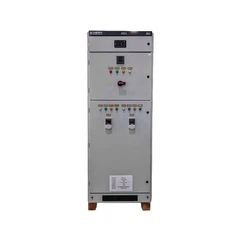
A Power Factor Controller Panel is designed to correct the power factor of an electrical system. It does this by automatically switching in or out capacitor banks to counteract the reactive power generated by inductive loads.
The panel is equipped with a power factor controller, which continuously monitors the power factor of the electrical system. When the power factor drops below a pre - set value, the controller sends a signal to switch in the appropriate capacitor bank. Capacitors generate reactive power that is opposite in phase to the reactive power generated by inductive loads. By adding the capacitive reactive power to the system, the overall reactive power is reduced, and the power factor is improved.
Conversely, when the power factor rises above the pre - set value, the controller switches out the capacitor banks to prevent over - correction. This dynamic control ensures that the power factor is maintained at an optimal level at all times.
Impact on Energy Efficiency
Now, let's discuss how Power Factor Controller Panels can improve energy efficiency.
Reduced Energy Losses
As mentioned earlier, low power factor leads to higher current flow in the electrical system. This increased current causes more energy to be lost as heat in the transmission lines and transformers. By improving the power factor, the current flowing through the system is reduced. According to the Joule's law of heating (P = I²R), where P is the power loss, I is the current, and R is the resistance of the conductor, a decrease in current results in a significant reduction in energy losses. For example, if the power factor is improved from 0.7 to 0.95, the current can be reduced by approximately 26%. This reduction in current means less energy is wasted as heat, leading to overall energy savings.
Avoidance of Utility Penalties
Many utilities charge penalties for low power factor. These penalties can be a significant cost for industrial and commercial customers. By using a Power Factor Controller Panel to improve the power factor, customers can avoid these penalties and save money on their electricity bills. For instance, some utilities may charge an additional fee of up to 10% of the total electricity bill for power factors below a certain threshold. By maintaining a high power factor, customers can eliminate this extra cost.
Increased Equipment Capacity
Improving the power factor also increases the effective capacity of electrical equipment. Since the current is reduced, the equipment can handle more real power without overloading. This means that existing equipment can be used more efficiently, and in some cases, the need for additional equipment can be postponed or even eliminated. For example, a transformer that was operating at a high load due to low power factor can now operate at a lower load after power factor correction, reducing the risk of overheating and extending its lifespan.
Real - World Examples
There are numerous real - world examples of how Power Factor Controller Panels have improved energy efficiency. In a large manufacturing plant, the installation of a Power Factor Controller Panel led to a 15% reduction in electricity consumption. The plant had a significant number of inductive loads, such as motors and transformers, which were causing a low power factor. After the installation of the panel, the power factor was improved from 0.65 to 0.92. This not only reduced the energy losses in the electrical system but also eliminated the utility penalties, resulting in substantial cost savings.


In a commercial building, the use of a Power Factor Controller Panel improved the power factor from 0.78 to 0.95. This led to a 12% reduction in the building's electricity bill. The building's management was also able to avoid the need for upgrading the electrical infrastructure, as the existing equipment could now handle the load more efficiently.
Related Products and Technologies
If you are interested in power factor correction, you may also want to explore related products such as Power Factor Correction Panel and Power Factor Improvement Panel. These panels are designed to work in conjunction with Power Factor Controller Panels to provide a comprehensive solution for power factor correction.
Additionally, Low - voltage AC Switchgear plays an important role in the overall electrical system. It provides protection and control for the electrical equipment, ensuring the safe and efficient operation of the system.
Conclusion
In conclusion, Power Factor Controller Panels can significantly improve energy efficiency. By correcting the power factor, they reduce energy losses, avoid utility penalties, and increase the effective capacity of electrical equipment. As a supplier of Power Factor Controller Panels, I have seen firsthand the positive impact these panels can have on energy consumption and cost savings.
If you are looking to improve the energy efficiency of your electrical system, I encourage you to consider investing in a Power Factor Controller Panel. Our team of experts can help you select the right panel for your specific needs and provide installation and maintenance services. Contact us today to start the conversation about how we can help you achieve your energy efficiency goals.
References
- Electric Power Systems: Analysis and Control by Claudio A. Cañizares
- Power System Analysis and Design by J. Duncan Glover, Mulukutla S. Sarma, and Thomas J. Overbye
- Electrical Engineering Handbook by Richard C. Dorf
Send Inquiry